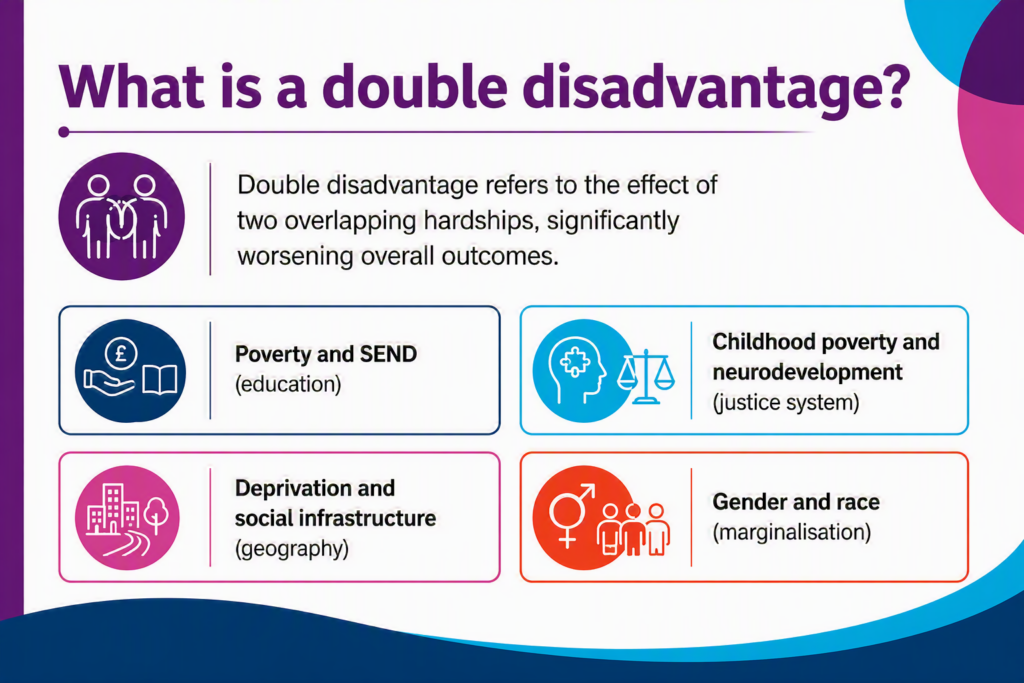
Image showing the definition of double disadvantage and examples of combined hardships. All text repeated from image repeated below.
Definition of double disadvantage
Most commonly, double disadvantage is a term used in education. It specifically describes, for example, children from poorer families who also have SEND (special educational needs and/or disabilities). This can mean the child in question may experience:
- worse outcomes in areas such as attendance, behaviour and achievement
- barriers to specialist support
In a general sense, double disadvantage describes a situation where an individual or community suffers from two overlapping, compounding forms of hardship.
Rather than existing independently, these two factors reinforce each other to create deeper and more systemic barriers that are harder to escape.
Around 4.5% of the UK population lives in an area where double disadvantage is more common.
Examples of double disadvantage
The following combinations are common examples of double disadvantage.
Gender and work
The phenomenon where women face dual burdens due to the intersection of their gender and their occupational roles. For example, pairing:
- motherhood pay penalty
- workplace discrimination, or balancing professional careers with disproportionate domestic duties
Race and socioeconomic status
Individuals who suffer from the combination of:
- systemic discrimination based on race or ethnicity
- economic disadvantages or poverty
Health and aging
The experience of older adults facing both:
- health issues
- socioeconomic hardships, such as lower income or isolation
Geographic and economic
Communities that suffer from both:
- rural isolation (lack of access to services)
- economic decline or lack of employment opportunities
How the double disadvantage affects digital exclusion
Sources:
The effect of experiencing two simultaneous barriers, such as low income alongside a disability, or living in a rural area alongside digital ageism, causes severe digital exclusion.
It traps individuals in a feedback loop where lack of online access worsens their social, health and economic inequalities.
Compounding financial and physical barriers
People facing socioeconomic challenges may struggle to afford hardware or data plans. When this overlaps with a disability or advanced age, the standard hardware is often insufficient.
This can force people to buy more expensive, specialised adaptive devices.
The ‘offline penalty’
Modern banking, health, civic and public services increasingly rely on digital interfaces, which can further deteriorate people’s socioeconomic status. Those who cannot get online are often forced to:
- use more expensive offline alternatives
- pay premium rates for goods
Constrained employment opportunities
Basic digital skills and reliable hardware are prerequisites for the modern workforce. When a lack of digital literacy combines with another barrier, like living in a remote area with poor connectivity, it practically eliminates access to remote work or digital job application systems.
Deepened social isolation
The internet is essential for maintaining community connections and accessing healthcare. When structural barriers trap marginalised groups offline, they suffer:
- higher rates of social isolation
- diminished access to telehealth services
Double disadvantage data in Luton
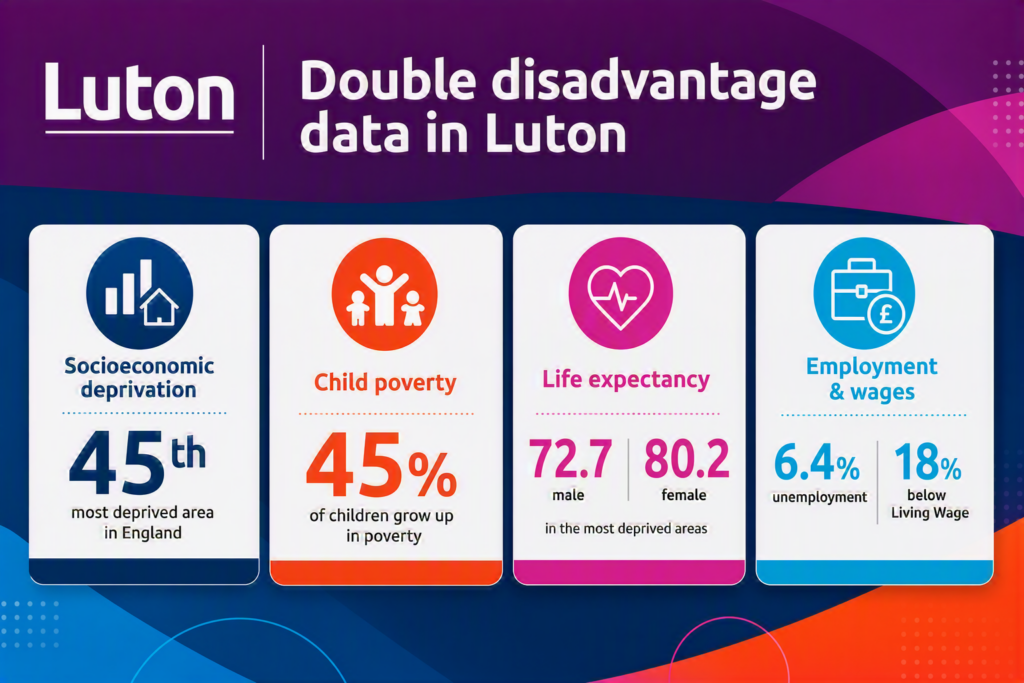
Image showing double disadvantage data in Luton. All data repeated in text.
Sources:
In Luton, double disadvantage refers particularly to neighbourhoods suffering from both:
- severe socioeconomic deprivation
- a critical lack of local social infrastructure
Specific areas, particularly South, Farley, and Northwell wards, face this crisis, driving high childhood poverty and life expectancy gaps of up to nine years between the town’s richest and poorest areas.
The intersection of poverty, poor infrastructure, and inequality in the borough manifests in several core areas.
The impact of double disadvantage in Luton
Doubly disadvantaged neighbourhoods in Luton experience compounded challenges, including:
- lower educational attainment
- poor health outcomes
- diminished community cohesion
Socioeconomic deprivation
Luton is ranked as the 45th most deprived area out of 296 local authorities in England. Severe economic pressures are concentrated in wards like Central, Farley, Lewsey, and Northwell.
Child poverty
Nearly 45% of children in Luton grow up in poverty and there remains a persistent and stark disadvantage gap in educational attainment for vulnerable students.
Life expectancy
Health is a major casualty of this disparity. Life expectancy in the most deprived areas of Luton is 72.7 years for males and 80.2 for females. In comparison, the least deprived areas in the UK have a longer life expectancy of 79.4 years for males and 85.6 for females.
Employment and wages
Luton faces an unemployment rate around 6.4% and approximately 18% of jobs pay below the national living wage.
How Luton is addressing the double disadvantage
Because of these compounding inequities, some of which are prevalent in Luton, we are actively implementing our Luton 2040 vision and fairness strategy, These plans and policies will address systemic barriers and rebuild vital social infrastructure.
Our aim is for Luton to be, by 2040, a healthy, fair and sustainable town where everyone can thrive, and no one lives in poverty. This work should help people experiencing double disadvantage.
How to help people experiencing double disadvantage
Helping people with a double disadvantage means we need to remove systemic barriers. This involves:
- removing barriers and simplifying access to support
- offering trauma-informed support where necessary
- targeting resources to high-need areas
- ensuring holistic, early intervention
- collaborating with community groups
- advocating for structural change
Find out more
For more information, see the following resources.
- Guidance on how to approach the double disadvantage (GOV.UK)
- Joining up services for people facing multiple disadvantage GOV.UK)
- Focusing on doubly disadvantaged neighbourhoods (Joseph Rowntree Foundation)

Like

Love

Haha